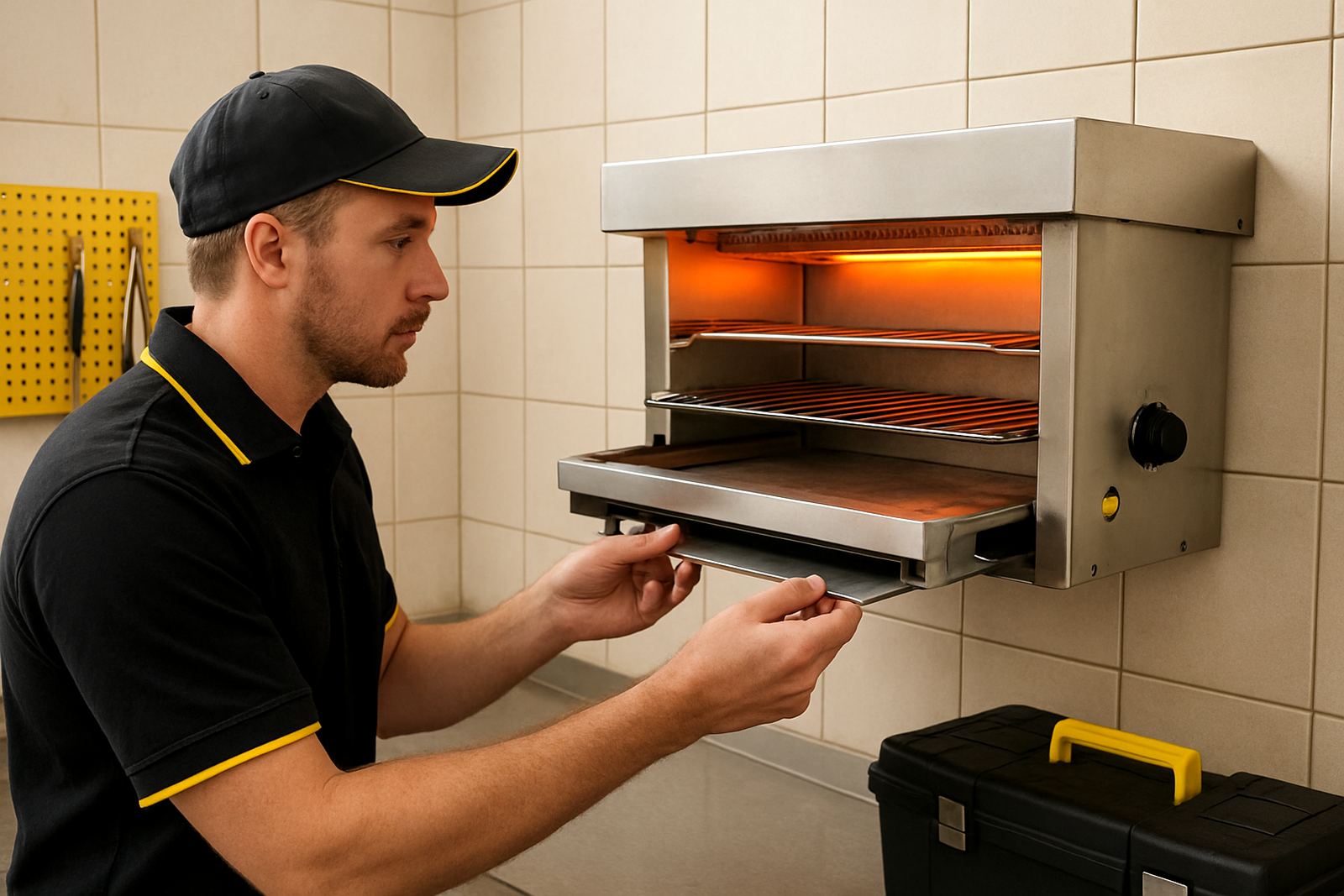
When a salamander starts running hot, cold, or uneven
A salamander is often the last stop before a plate leaves the pass, so faults show up quickly. You may see slow warm-up, hot spots on one side, a door or lift that no longer holds position, or a unit that cuts out mid-service. In many kitchens the problem starts small, then becomes a daily delay during breakfast, lunch or dinner rush.
The usual client is a restaurant, hotel, takeaways, butcher shop, forecourt kitchen, school or a catering team using top heat for browning, melting and finishing. In coastal areas such as Durban or Port Elizabeth, moisture can work into terminals and switches. Inland, dust and heat around Johannesburg and Pretoria can age controls faster than expected, especially where equipment runs frequenty through long shifts.
When a salamander is kept in service with the wrong part, the result is uneven colour, wasted product and a larger repair later. We help identify the part, check compatibility, and match it to the model before anything is sent out.
The parts most often replaced on commercial salamanders
Most salamander callouts are not about the frame or body of the unit. They are about the upper heat and control items that take repeated cycling, grease exposure and cleaning heat. The common replacements are simple in name, but the match has to be right for size, voltage and mounting.
- Heating elements for top heat and browning
- Thermostats and temperature controls
- Switches, indicator switches and control knobs
- Terminal blocks and internal wiring connectors
- Door gaskets or heat seals where fitted
- Burners and ignition-related parts on gas units
- Timers and safety cut-out components
If a salamander is part of a line-up with ovens, fryers or a hot holding station, it is worth checking all nearby controls at the same time. A weak thermostat or tired switch can cause repeated faults, not just one bad service call.
Planning the layout around the pass and prep line
A salamander should be easy to reach, easy to clean and safe for staff working under pressure. In a busy pass, there must be enough clearance above the unit for heat escape and enough working room in front for pan handling. If the salamander is wall mounted, the fixing points and power or gas route should be checked before parts are swapped.
Good planning also means thinking about workflow. If the unit is used for final browning on steaks, toasties or plated vegetables, it should sit close to the plating area but not where staff will knock the controls with trays. Where a kitchen faces load-shedding or generator changeover, check that the unit’s electrical load is known and that the supply is stable enough for the elements and controls.
For sites in Cape Town, Stellenbosch or the coastal belt, corrosion protection matters on screws, brackets and terminals. In Bloemfontein or other drier inland towns, the bigger issue is often heat build-up and neglected cleaning around the control area. Small layout choices save parts later.
Common mistakes that turn a small fault into a bigger repair
The most common mistake is fitting the nearest looking part without checking the rating or dimensions. A salamander element may fit in place but still draw the wrong load, run too hot, or leave cold corners. Another common error is replacing only one failed item when the wiring, switch or thermostat has also taken strain.
- Using a part by appearance only, without confirming the model
- Ignoring burnt terminals, loose earths or heat-damaged wire ends
- Cleaning with excess water and soaking control panels
- Running a unit with the door or lift mechanism sticking
- Skipping post-fit testing after a replacement
In our experience, the parts that fail twice are often the parts that were not checked properly the first time. A quick compatibility check saves time and keeps the kitchen moving.
Budget ranges for salamander parts and fitting in Rand
Budgets depend on whether the fault is a simple switch, a thermostat, or a heating element set. Small control parts can start from a few hundred Rand, while elements, burners or more complex assemblies can move into the low thousands. Onsite fitting, where needed, adds labour and travel, especially outside Gauteng.
As a rough guide, many salamander jobs fall into these bands:
- Basic switches, knobs or terminals: R250 to R900
- Thermostats and control parts: R650 to R1 800
- Elements or burner-related parts: R900 to R3 500
- Fitting, testing and call-out support: R650 to R2 500+
If a site has several units or a full back-of-house line-up, it often makes sense to group the work. That lowers repeated travel and keeps the replacement plan practical.
How FoodServ Parts Store handles salamander support nationwide
We work from Midrand and supply kitchens across Johannesburg, Pretoria, Durban, Cape Town and beyond. Our team checks part details, compares the old item to the new one, and helps avoid the costly mistake of ordering a near-match that does not last. For salamanders, that means paying close attention to element shape, thermostat range, switch layout and mounting points.
The service team can assist with part identification, compatibility checks, element fitting, thermostat fitting, gasket fitting, burner fitting, switch panel repairs, dishwasher part fitting, onsite parts support and post-fit testing. For kitchens that cannot afford long downtime, the aim is simple: get the right part out, fit it properly, and confirm the unit is back in service.
If a salamander is down during peak trading, send the unit details, a photo of the faulty part, and the model plate if it is still readable. That usually shortens the turn-around and helps avoid back-and-forth on teh part match.