What a door latch does in daily kitchen use
A door latch is the part that catches the door and holds it tight against the cabinet or frame. On commercial ovens and dishwashers this matters more than people think, because even a small gap can lead to heat loss, steam leak-off, poor wash results or a door that keeps working itself open during busy service.
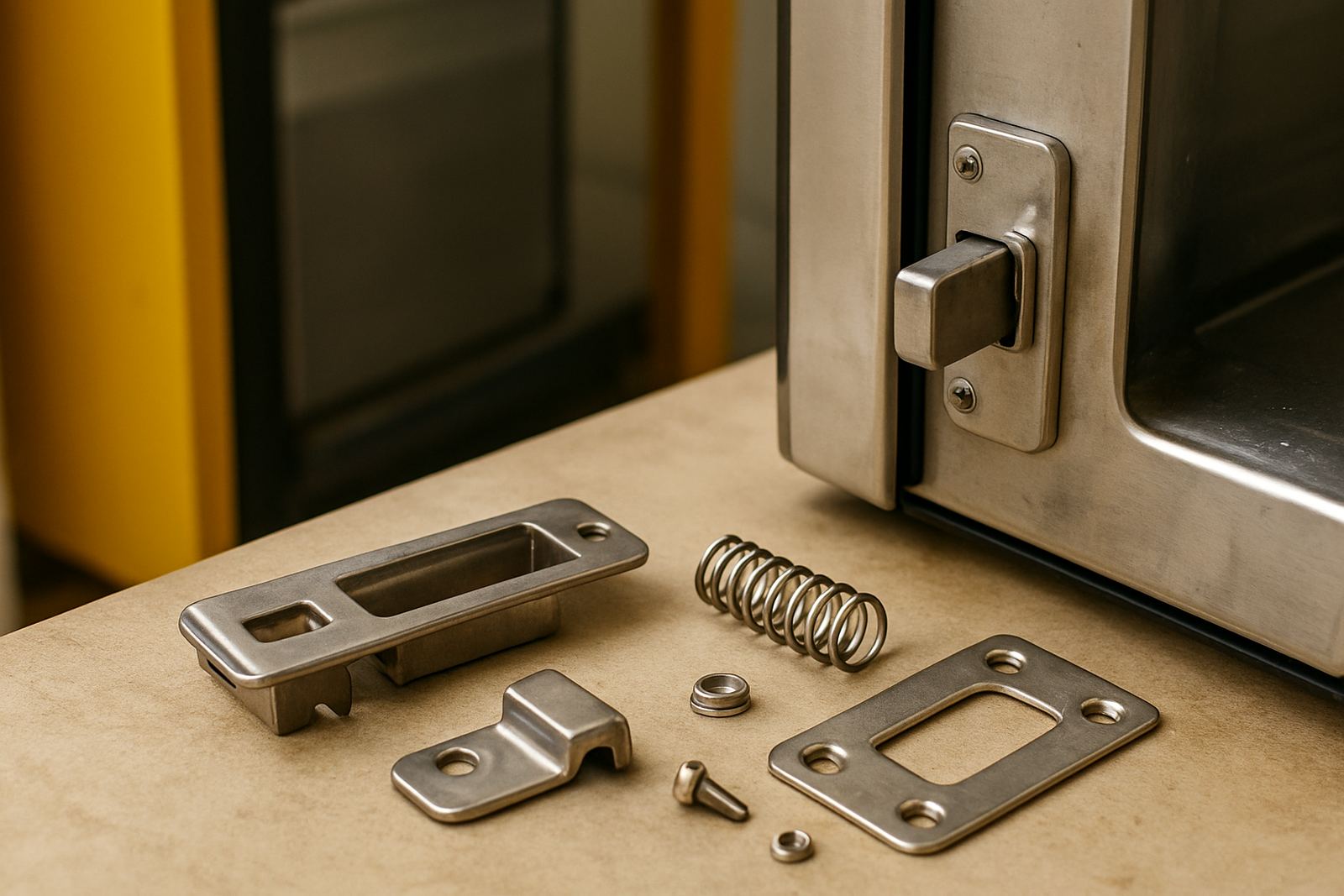
Most latch assemblies include the catch, spring action and mounting points that bring the door back into line. When the handle feels normal but the door still will not stay closed, the latch tongue, striker or spring may be worn. In busy kitchens around Midrand, Johannesburg, Pretoria and the coast, these parts wear faster where doors are opened and shut hundreds of times a day.
FoodServ Parts Store supplies replacement latch parts for commercial kitchen equipment used in bakeries, restaurants, canteens, takeaways and institutional kitchens. We help match the part to the machine so you are not left with a door that looks right but will not lock properly.
Latch sizes and style options we supply
Door latches come in different lengths, fixing centres and catch styles. Some are compact spring latches for lighter doors, while others are heavier assemblies built for insulated oven doors or high-use dishwasher doors. The fixing holes, offset and striker position all need to line up, otherwise the door will close but not seal properly.
When checking a replacement, the most useful details are the old part number, overall length, hole spacing and whether the latch is left-hand, right-hand or centre mounted. If the original is broken or missing, a clear photo with a tape measure beside it helps a lot. We can work from that and confirm the nearest compatible option.
- Light-duty door catches for smaller oven doors
- Heavy-duty latch assemblies for commercial ovens
- Dishwasher door latches with spring return action
- Strikers, catches and keeper plates
- Mounting screws and fixing hardware where supplied
Where these latches are commonly fitted
Door latches are used on ovens, combination cooking equipment and dishwashers where the door must stay closed under heat or pressure. In an oven, the latch helps maintain temperature and keeps the door sitting flush. In a dishwasher, it supports the wash cycle by keeping the door shut against spray and water pressure.
We most often see worn latches on under-counter ovens, single and double cavity units, pass-through dishwashers, pot washers and front-loading machines in shared kitchens. Coastal humidity in Durban, Cape Town and other sea-facing areas can also affect the spring action and cause metal parts to pit, seize or go stiff over time.
If the door has started bouncing open, needs a hard slam to catch, or sits slightly proud at one corner, the problem may not be the hinge. The latch and striker should be checked together, because replacing only one side can leave the fault unresolved.
Installation and what the equipment needs before fitting
Most latch replacements are straightforward, but the machine must be isolated before any work starts. Ovens need power switched off at the breaker and any gas supply closed and checked safe before panels are opened. Dishwashers should be isolated electrically and water supply shut off if access is needed near the cabinet or door area.
Some latch jobs only need basic hand tools and a careful alignment check. Others involve removing inner door panels, adjusting springs or setting the striker position so the door closes without force. If the latch is fitted too tight, the handle may strain. Too loose, and the door can rattle open mid cycle.
- Turn off electrical supply before opening the unit
- For gas ovens, isolate gas and confirm there are no leaks
- Check hinges and door seals at the same time
- Test the latch action several times before returning to service
After fitting, the door should close with firm pressure but not an ugly slam. On ovens, the seal must sit even all the way around. On dishwashers, check for any water seepage around the door edge during a test cycle.
Care, servicing and signs the latch is wearing out
Regular cleaning helps door latches last longer. Grease, flour, detergent build-up and burnt-on residue can get into the catch area and stop the spring from moving freely. Wipe the latch and striker during routine kitchen cleaning, and avoid forcing the handle if the door starts to stick.
In many cases a latch begins to fail slowly. The door still closes, but not with the same pull. Then the handle becomes harder to move, the catch rattles, or the door needs a second push. Catching this early can prevent heat loss, damaged seals and extra wear on hinges and frames. A small issue can turn into a bigger repair, especially in kitchens that run all day.
If a latch has already broken, do not keep using the machine with the door held shut by weight or makeshift clips. That can bend the frame or damage the strike plate, which adds to the repair cost later.
What to check before you place an order
The safest way to order the right latch is to compare the old part carefully. Many look similar at first glance but differ by a few millimetres, and that is enough to make the door sit wrong. Check the type of machine, door orientation and any markings stamped into the old latch body or spring plate.
Photos are very useful, especially if you can show the front, back and side of the latch, plus the door edge and the striker area. If the equipment is in a busy kitchen and cannot be taken apart yet, measure what you can and send the details through. We help with part identification and compatibility checks before dispatch from our Midrand base.
- Equipment make and model, if available
- Door type: oven, dishwasher or other commercial unit
- Left-hand or right-hand mounting
- Overall length and fixing hole spacing
- Condition of the striker, hinge and seal
- Photo of the old latch next to a ruler or tape measure
National supply from Midrand with practical support
FoodServ Parts Store supplies door latches nationally from Midrand, with coverage into Johannesburg, Pretoria, Durban, Cape Town and Bloemfontein. We are set up for the realities of commercial kitchens, including quick turnarounds after failure, load-shedding related wear on equipment and the kind of parts matching that saves time on site.
For customers who need more than a box of parts, our team can assist with fitting support, post-fit testing and on-site parts help where required. That includes checking whether the latch problem is linked to a warped door, tired spring or damaged seal. If you are unsure, send the part details first and we will help narrow it down before you order.
We keep the process practical: identify the latch, confirm the fit, dispatch from Midrand, then make sure the door closes as it should once the part is fitted. That is the aim, no fuss and no wasted downtime.
Key facts
| Product type | Replacement door latch assemblies and related catch parts |
|---|---|
| Typical use | Commercial oven and dishwasher doors |
| Mounting | Left-hand, right-hand or centre mounted depending on model |
| Material | Metal body with spring action and fixing hardware |
| Checks needed | Length, fixing centres, striker position and door orientation |
| Support | Part identification, compatibility checks and fitting support |