What fan blades do inside commercial cooking equipment
Fan blades move heated air across the cooking cavity so temperature stays as even as possible from side to side and front to back. In convection ovens that matters a lot, because a bent, worn or incorrectly sized blade can cause hot spots, pale corners, slow recovery after door openings and longer cook times. In busy kitchens that turns into wasted power, uneven product and extra callouts.
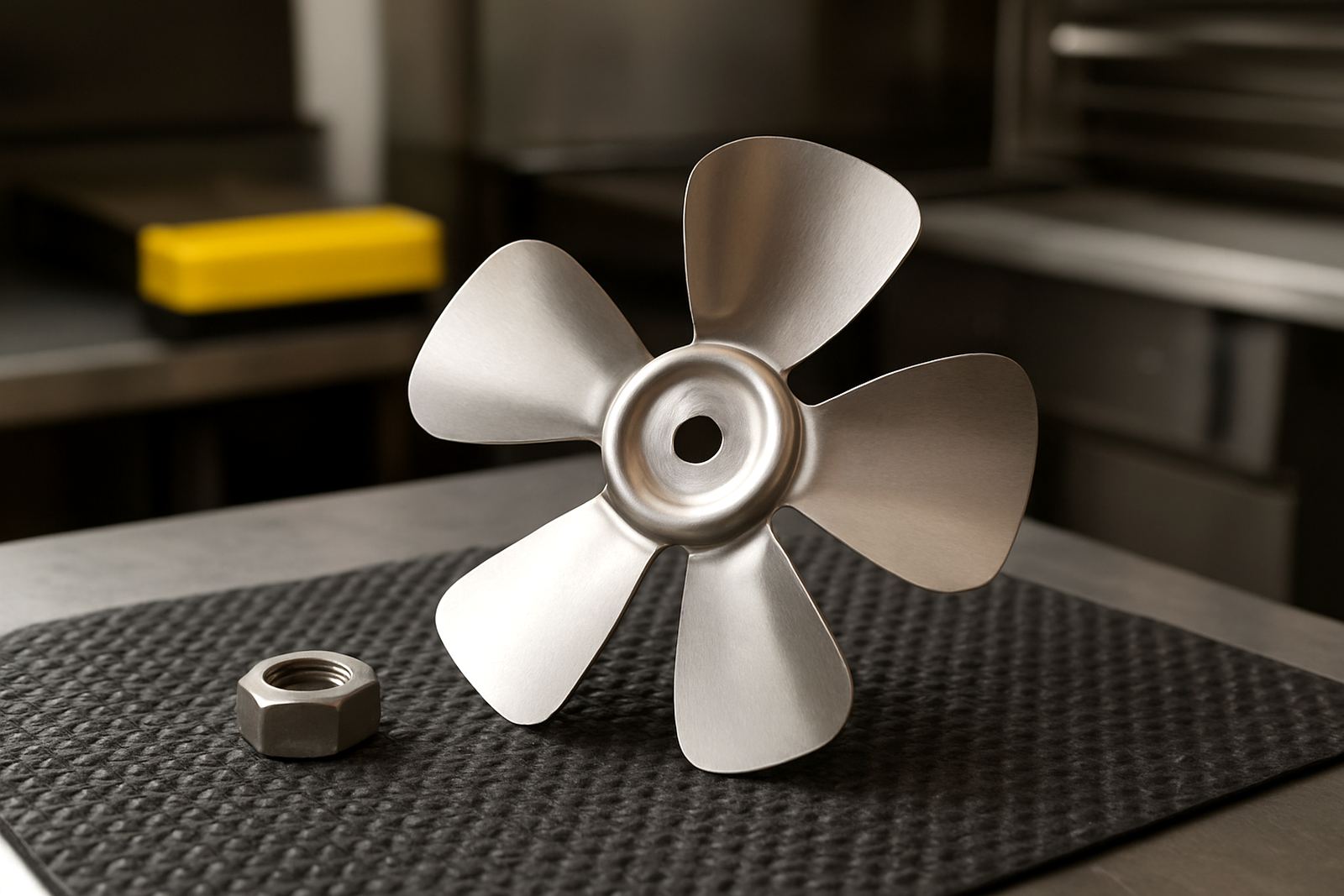
These replacement blades are used in equipment where a motor drives air across the chamber. They are commonly fitted in convection ovens, combi-style cooking units and some warming or circulating systems. The correct blade size and pitch need to suit the motor output and the housing clearances, otherwise the blade can rub, create noise or draw more current than it should.
At FoodServ Parts Store we help match the blade to the equipment by checking measurements, hub style and blade direction. If the old part is damaged beyond reading, send clear photos and any plate details you still have. That usually saves a second trip and helps avoid the wrong item landing in your workshop.
Blade sizes, hub types and airflow options
Fan blades are not one-size-fits-all. The main points are diameter, number of blades, hub bore, fixing method and whether the blade moves air clockwise or anti-clockwise. Some units use a shallow pitch blade for steady circulation, while others need a steeper angle to push air through a larger cavity. A blade that is too large can hit guards or the casing. A blade that is too small may spin fine but still underperform.
Common options we assist with include:
- Measured diameters for compact, mid-size and large oven cavities
- Different hub bores and centre fixings for direct motor fitment
- Left hand or right hand rotation to suit the motor direction
- Single-piece blades and units with removable hub sections
- Stainless and plated finishes for different heat and moisture conditions
For kitchens near the coast, such as Durban, a metal finish that copes better with humidity can help reduce early rust marks. In places where equipment runs long hours and sits close to gas lines or steam, checking the clearances around the blade guard is just as important as the diameter itself. One mm out at the hub can be enough to cause contact.
Where replacement fan blades are best suited
These blades are suitable for ovens and heating equipment that rely on forced air movement rather than still heat. That includes convection ovens in takeaways, bakeries, hotels, school kitchens and catering vehicles. They are also relevant where a unit has started sounding rough, the fan is wobbling, or the cook is noticing patchy browning and slower heat return after the door opens.
We often see requests from kitchens in Johannesburg, Pretoria, Midrand, Bloemfontein, Cape Town and Durban where equipment works hard through breakfast, lunch and supper service. In a high-volume site the blade needs to move air consistently without vibration. If the motor bearings are already worn, fitment should include a full check because a new blade will not fix a loose shaft.
- Convection ovens with uneven tray colour or slow recovery
- Heating cabinets and circulating units where air movement has dropped
- Commercial ovens showing fan noise, scrape marks or wobble
- Units that have had a past blade strike after cleaning or impact
How to install and what power or gas checks matter
Fan blade replacement is usually straightforward for a qualified technician, but the unit must be isolated properly before work starts. On electric ovens, power should be switched off at the isolator and tested dead before the guard is removed. On gas equipment, the gas supply must be closed and the appliance allowed to cool fully. Never force a blade onto a shaft, because a tight fit can damage the motor or throw the fan out of line.
During fitting, the technician should confirm shaft condition, keyway or grub screw security, blade clearance and rotation direction. If the motor has been rewired or a control board replaced, the direction can change and the blade may need to be checked again. After fitment, run the unit at operating temperature and listen for rubbing, vibration or irregular airflow. Post-fit testing helps catch problems before service resumes.
If the oven has recently suffered from load-shedding interruptions, voltage dips or repeated restarts, it is worth checking the motor and any speed control parts at the same time. A blade can be perfectly good but still sit in a system that is already under strain. That is why our parts team asks about the full fault story, not just the visible damage.
Care, cleaning and signs the blade should be changed
Fan blades live in a hot, greasy environment, so cleaning matters. Build-up on the blade edges changes balance and airflow, and hard deposits can throw the assembly out of line. Wipe-downs should be done only once the unit is isolated and cool. Avoid soaking the motor area or using harsh cleaners that leave residue on bearings and fixings.
Change the blade if you see any of the following:
- Cracks, bends or missing material on the blade edges
- Rust pitting or sharp corrosion around the hub
- Repeated wobble after cleaning and refitting
- Scrape marks on the guard, side wall or chamber lining
- Cooking results that show one side browning faster than the other
Where the oven runs in a busy coastal kitchen, small corrosion marks can turn into balance problems faster than expected. If the blade is already noisy or has a visible nick, replacement is usually the better option than trying to straighten it. A repaired blade can fail again without warning, and that is not worth the risk in a commercial kitchen.
What to send us before ordering the right blade
To order the correct fan blade, send the appliance make and model if you have it, plus a clear photo of the old blade and the motor shaft. We also need the diameter across the widest point, hub bore size, fixing type and the direction of rotation. If the old part is broken, measure the remains as best you can and note where the break occurred.
Useful checks before you place the order:
- Blade diameter in mm
- Hub bore and shaft size in mm
- Number of blades and pitch angle if visible
- Rotation direction as viewed from the motor side
- Clearance inside the fan housing
- Any part numbers or plate details on the oven
If you are not sure, our parts team can do the compatibility check for you and advise on the nearest match. That is especially helpful where the appliance has had repairs over the years and a previous owner changed components. Send details to parts@foodservparts.co.za and we will help from there.
Key facts
| Product type | Replacement fan blades for commercial convection equipment |
|---|---|
| Material options | Stainless steel or plated metal, depending on application |
| Diameter range | Common sizes supplied to suit compact to large ovens |
| Fixing types | Direct shaft fit, hub-mounted and grub screw styles |
| Rotation | Clockwise or anti-clockwise options available |
| Supply area | Nationwide dispatch from Midrand, with support across South Africa |