What wash arms do in a commercial dishwasher
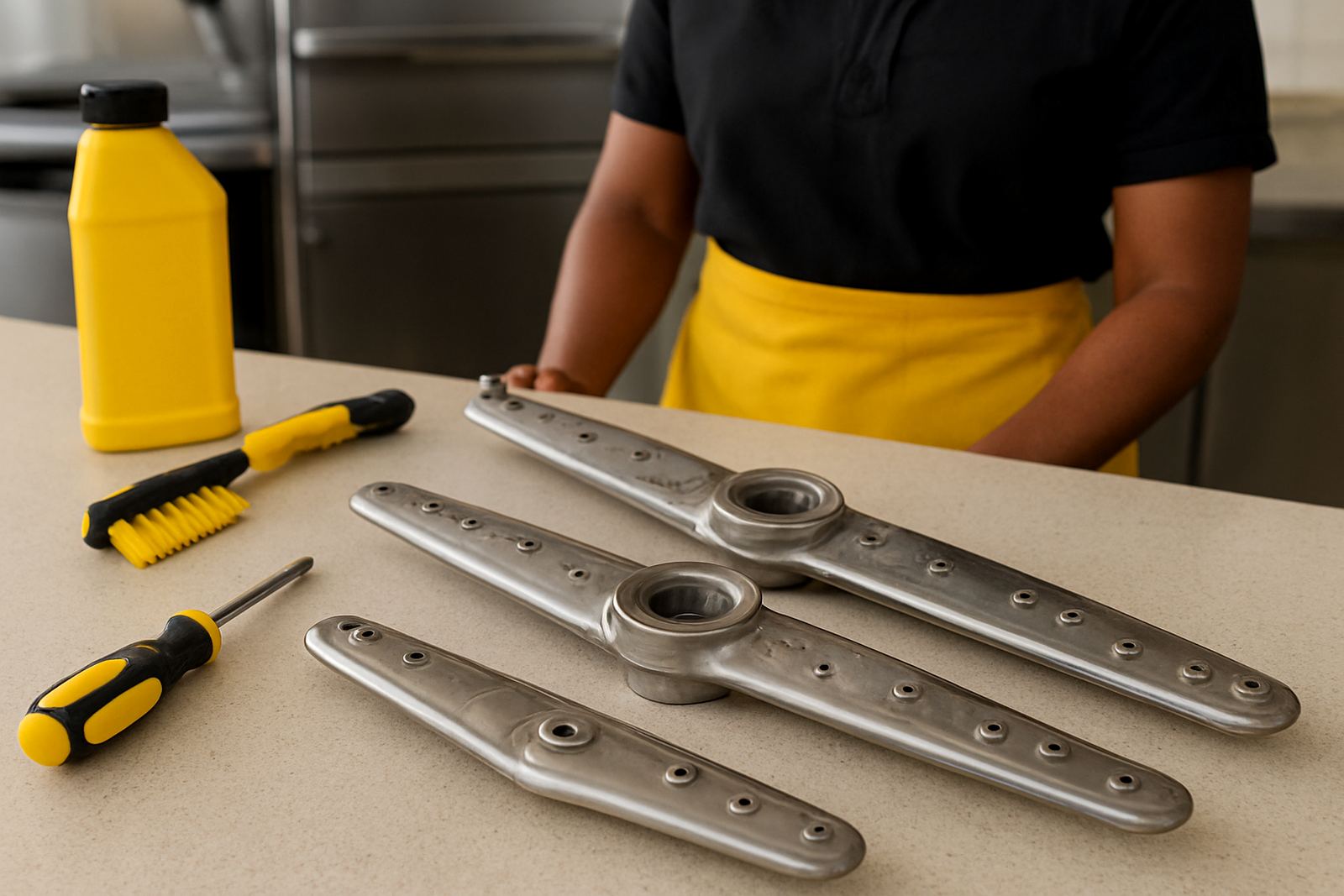
Wash arms are the rotating spray bars that sit inside the wash chamber and push water through a line of jets. The movement is driven by water pressure, not a motor, so if the jets are blocked by scale, food bits or broken fins, the arm cannot turn as it should. That leads to patchy washing, soap residue, and glasses or plates that need to go back through again.
In busy kitchens around Midrand, Johannesburg, Pretoria and the coast, wash arms take a fair amount of punishment. Hard water, grease build-up and poor pre-rinse habits all shorten service life. A worn arm can still look fine from the outside, but one split jet or a warped hub can throw the spray pattern off enough to affect the whole cycle.
We supply upper and lower wash arms for commercial dishwashers used in restaurants, hotels, school kitchens, canteens and food production areas. The right replacement must match the machine type, mounting style and overall length, otherwise the spray path will not line up properly.
Sizes, mounting styles and common options
Wash arms come in different diameters, lengths and hub sizes. Some machines use a single lower arm only, while others use both an upper and lower arm for full coverage. On hood-type machines the arm set is usually wider and easier to remove for cleaning, while undercounter units often use a more compact design with tighter clearance.
When ordering, it helps to check the following points before you send through a part request:
- Total arm length in millimetres
- Centre hub diameter and fixing style
- Number of jets and jet spacing
- Upper arm, lower arm or both
- Material type, usually plastic or metal
- Rotation direction or handed design if the machine uses one
Some arms have removable end caps or screw-in jet inserts, while others are one-piece moulded parts. If the machine sees heavy use, a model with stronger wall thickness can last longer, especially where staff are loading trays fast and not always clearing crumbs first.
Where wash arms suit best
These parts suit commercial dishwashers in front-of-house and back-of-house kitchens where daily wash volumes are high. They are commonly used in small cafes, takeaway kitchens, hotels, franchise outlets, bakeries and institutional kitchens that wash a steady mix of plates, pots and utensils. If the spray pattern has become weak or the machine leaves detergent marks, the wash arm is often one of the first parts to inspect.
Upper and lower wash arms are especially important where water quality is hard or where machines run many cycles during peak meal times. In coastal towns like Durban and Cape Town, salt air and humidity can add to general wear on clips, seals and fasteners, so regular checks matter. Inland sites may not deal with the same air moisture, but scale from borehole or municipal supply can still block jets quickly.
For kitchens with repeat breakdowns, it is worth checking the arm alongside the filter, pump screen and rinse nozzles. If one part is blocked, the arm may be blamed when the real issue sits elsewhere. That saves money and stops unnecessary replacements.
Installation checks and machine requirements
Wash arms do not need electrical power or gas on their own, but they depend on the dishwasher being set up correctly. Water pressure, inlet temperature, pump condition and spray arm clearance all affect how well the part performs. If the machine has low pressure, blocked filters or a weak pump, even a new arm can still wash badly.
Before fitting, make sure the machine is isolated, drained and cool enough to handle. Check that the mounting point is not cracked and that the arm spins freely by hand. If the centre bush is worn or the retaining clip is loose, the arm can wobble and strike racks or the chamber wall. That can cause noise, poor wash coverage and damage to the new part.
- Do not overtighten retaining nuts or clips
- Check clearance with the top and bottom racks in place
- Flush the machine after fitment to clear loose debris
- Test rotation during a full wash cycle before handing back to staff
Our team can assist with part identification, compatibility checks and post-fit testing, which helps when the machine model plate is worn or the old arm is missing. A quick check now can prevent the wrong part being sent out twice.
Care, cleaning and service life
Wash arms last longer when they are cleaned as part of the normal kitchen routine. Staff should remove them regularly, rinse out the jets and check for limescale, grease and rice grains or other hard debris. If the holes start to close up, the spray becomes uneven and the machine needs more cycles to get the same result. That costs water, detergent and time.
For sites with hard water, a descaling routine helps keep the jets open. Do not poke the holes with wire that is too thick, because that can enlarge the jet and change the spray pattern. A soft brush, warm water and the correct cleaner are usually enough for routine servicing. Where the arm has cracked or warped, cleaning will not solve the issue and replacement is the better call.
Look out for noisy turning, wet patches on one side of the rack, and dishes that are clean on top but still dirty underneath. Those are classic signs that the arm is not distributing water evenly. In many cases the machine is still running, but it is no longer doing its job properly.
What to check before you order a replacement
The best way to avoid delays is to compare the old part against the machine details before ordering. If the arm has broken in two, take a photo of the hub, jet layout and fixing end. If the part is still in place, measure it from end to end and note whether it sits in the upper or lower position. These details help avoid a mismatch on delivery and save time for kitchens that cannot stay down for long.
Useful details to send through include the dishwasher make and model, the arm position, the diameter, and whether the jets face straight out or at an angle. If the machine was fitted by a previous contractor, do not assume the part number is still correct. Older machines can carry changes made during a repair years ago, and that can catch people out.
- Machine make and model
- Serial or data plate photo if available
- Upper or lower arm position
- Old part photo from both sides
- Any visible wear, cracking or missing jets
We dispatch from Midrand with national coverage, and we help customers in Johannesburg, Pretoria, Durban, Cape Town and Bloemfontein identify the right dishwasher parts the first time. If you need help matching an arm to the machine, send the details through and we will check it before anything is supplied.
Key facts
| Product type | Commercial dishwasher wash arms |
|---|---|
| Positions | Upper wash arm, lower wash arm, or matched pair |
| Common materials | Plastic or metal, depending on machine design |
| Typical sizes | Measured by overall length, hub size and jet spacing |
| Use | Replacement for blocked, cracked or poorly rotating spray arms |
| Support | Part identification, compatibility checks, fitment and post-fit testing |