How a capillary thermostat controls commercial heat
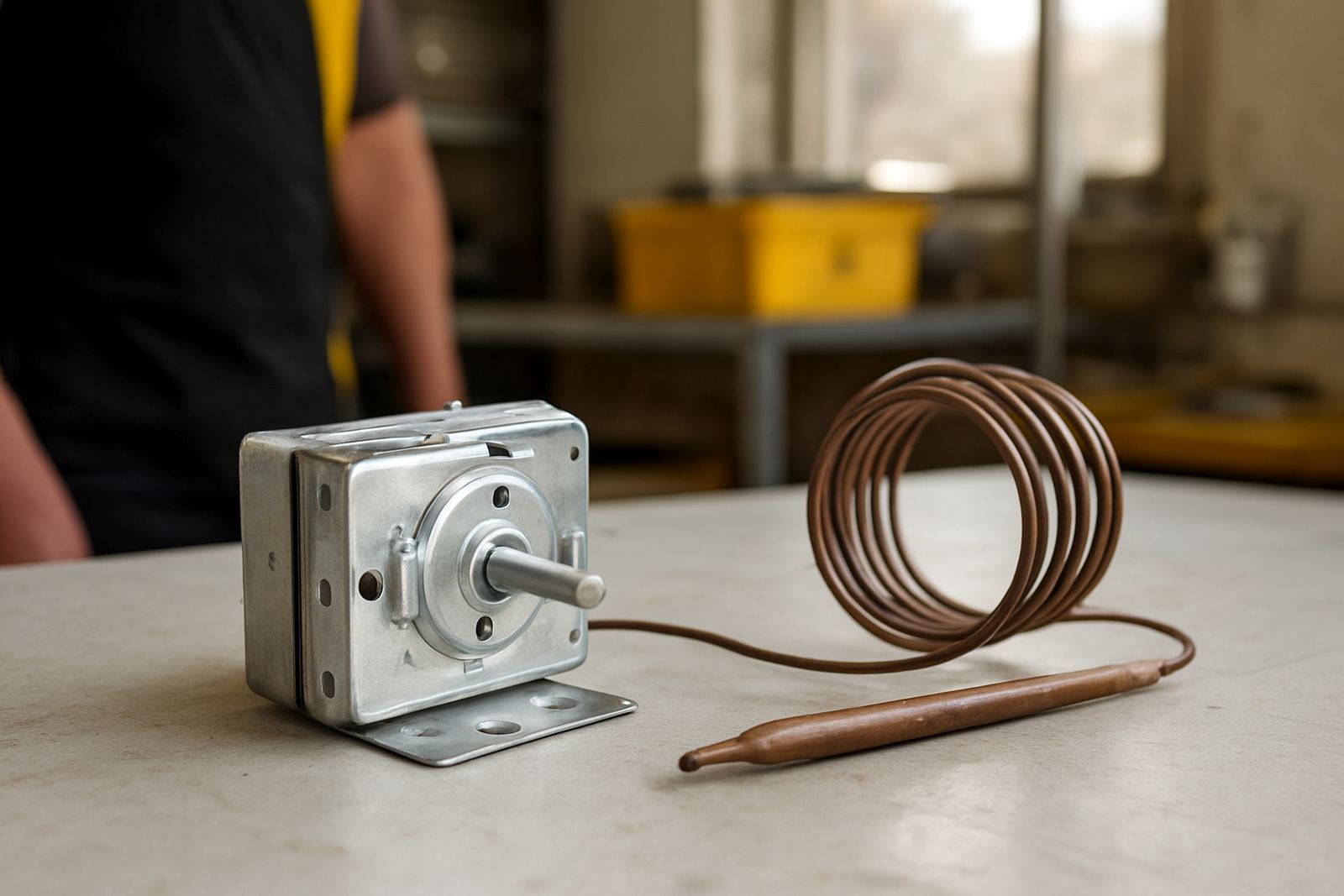
A capillary thermostat uses a sensing bulb placed in the hot zone, a thin capillary tube, and a control body with the switching contacts. As the bulb warms up, the internal charge expands and moves the control mechanism. That opens or closes the circuit at the set temperature, which keeps heat steadier than a simple on or off switch. In busy kitchens this matters a lot because one degree off can change baking colour, frying time, or holding temperature.
These thermostatst are common on deck ovens, chip fryers, hot cabinets, bain maries and some dishwasher heating circuits. They are mechanical parts, so they do not need a control board to work, but they must match the appliance design and temperature range. If the sensing bulb is damaged, kinked or installed in the wrong place, the thermostat will not read properly and the appliance can overheat or underperform.
Sizes, ranges and mounting options to match
Capillary thermostats are not one size fits all. The control range, spindle style, capillary length and bulb size all need to suit the appliance. Some units are built for low to medium heat, while others are made for fryer control or higher oven temperatures. The mounting face can differ too, with different shaft lengths, bracket positions and bulb fittings.
- Typical temperature ranges include 50 to 300 degrees C, depending on the application.
- Capillary lengths often vary from about 600 mm to 1500 mm.
- Bulbs may be straight, curved, or fixed in a pocket or clip.
- Spindle shafts can be plain, slotted, or D shaft style for the control knob.
- Some models include manual reset or safety cut-out functions.
For a direct replacement, compare the old part carefully. Check the numbers on the body if they are still readable, and measure the sensing route before you order. A capillary that is too short or forced into a tight bend will fail early, especially where the kitchen runs hard during service and there is vibration from doors, drawers and fans.
Where capillary thermostats are used in kitchens
These thermostats suit a wide mix of commercial equipment. In ovens they help regulate baking chambers and cabinet heat. In fryers they manage oil temperature so food cooks at the right speed without scorching. In heated cabinets and holding drawers they keep cooked food warm without drying it out. Some dishwashers use them for wash tank or rinse heating control, although the exact setup depends on the machine design.
They are a practical choice for kitchens that need simple control and quick changeover parts. That includes restaurants, canteens, bakeries, butcheries, takeaway shops and hotel kitchens. If your site is on the coast, the control body and terminals should be checked for corrosion more often because salty air can work into the cabinet. In inland areas, dust and grease are usually the bigger issue, especially near extraction fans and open prep lines.
- Ovens and pizza ovens
- Deep fryers and chip fryers
- Food warmers and heated cabinets
- Dishwashers with heating circuits
- Grills and speciality cookers
Installation points, power checks and gas safety
Before fitting a new thermostat, isolate the appliance fully and confirm there is no live supply at the terminals. On electric equipment check the voltage rating, current rating and the terminal layout. On gas appliances the thermostat may be part of a safety chain, so the replacement must suit the burner control and ignition sequence. If the appliance has both gas and electric controls, treat each circuit separately and test them one by one.
Good installation depends on correct bulb placement. The sensing bulb must sit where the appliance maker intended, not against a heating element or loose in the cavity. If it is clamped too close to direct flame or bent sharply behind a panel, it can give false readings or fail early. Keep the capillary clear of sharp edges and moving parts, and do not shorten or join it in the field unless the part is made for that type of repair. If the unit trips after a load-shedding restart, check for damaged contacts and loose terminals before replacing the thermostat again.
What to check before ordering the right part
The fastest way to avoid a wrong order is to compare the old thermostat with the replacement on five points: range, capillary length, bulb style, spindle style and mounting type. If the old unit has a faded label, send a clear photo of the body, terminals and sensing bulb. A photo of the appliance nameplate also helps, because the same cabinet or oven can use different parts in different production runs.
- Temperature range marked on the body
- Length of the capillary from body to bulb
- Bulb shape and diameter
- Control shaft size and rotation type
- Terminal layout and wire count
- Appliance make, model and serial plate details
For ovens and fryers, also check whether the control is a regulating thermostat or a safety limit thermostat. They are not interchangeable. If your kitchen is in Johannesburg, Pretoria, Durban, Cape Town or Bloemfontein, we can work from photos and measurements so you do not waste time taking the unit apart twice.
Care, servicing and signs of wear
Capillary thermostats last longer when the control area is kept clean and dry. Grease build-up around the knob or panel can hide heat damage, and vibration can loosen the terminals over time. During routine service, inspect the bulb for dents, the capillary for kinks, and the contacts for heat marks. If the appliance is cycling too often, overshooting the set temperature, or not turning on until it is tapped, the thermostat may be wearing out.
On site we often find the fault is not only the thermostat. A burnt terminal, damaged gasket, blocked airflow, or a failed element can make the control look faulty when it is not. That is why post-fit testing matters. After replacement, let the unit run through a full heat cycle, check cut-in and cut-out response, and make sure the knob marking matches the actual temperature feel. Small drift is normal, but a wide swing means the part or the installation needs another look.
Key facts
| Product type | Capillary temperature control thermostat |
|---|---|
| Typical use | Ovens, fryers, heated cabinets and some dishwashers |
| Temperature range | Approx. 50 to 300 degrees C depending on model |
| Capillary length | Commonly 600 mm to 1500 mm |
| Bulb style | Straight, curved or pocket mounted sensing bulb |
| Installation note | Bulb placement and terminal layout must match the appliance |
| Supply compatibility | Suitable for electric or gas controlled heating circuits, model dependent |